
Ahmedabad's Points Table Is Lying: Bangladesh Isn't Third — It Hasn't Played Yet
**मुख्य उत्तर**: कॉमनवेल्थ कबड्डी चैंपियनशिप 2026 के पहले दिन की पॉइंट्स टेबल भ्रामक है, क्योंकि स्कोर डिफरेंस से रैंकिंग के कारण बिना खेले टीमें (नाइजीरिया, बांग्लादेश, कनाडा) मध्य क्रम में बैठी हैं। **मुख्य तथ्य**: - ग्रुप A में सात और ग्रुप B में छह टीमें; पहले दिन पांच मैच खेले गए। - स्कॉटलैंड ने ऑस्ट्रेलिया को 59–30 से हराया, दिन का सबसे बड़ा 89 अंकों का मुकाबला। - लवप्रीत बराड़ के 23 रेड अंक स्कॉटलैंड के कुल 59 अंकों का कम से कम 39 प्रतिशत हैं। - केन्या ने सिंगापुर को 48–28 से और यूगांडा ने मलेशिया को 45–29 से हराया। - ईरान और दक्षिण कोरिया इस आयोजन से बाहर हैं; कबड्डी कॉमनवेल्थ गेम्स का खेल नहीं है। **स्रोत**: केल नाउ (Khel Now), कॉमनवेल्थ कबड्डी चैंपियनशिप 2026 पुरुष पॉइंट्स टेबल, दिन 1, अहमदाबाद | Cross-checked: cricsultan.com **संबंधित प्रश्नोत्तर**: प्रश्न: ग्रुप B में बांग्लादेश तीसरे स्थान पर क्यों है? उत्तर: बांग्लादेश ने अभी कोई मैच नहीं खेला; स्कोर डिफरेंस आधारित रैंकिंग में हारने वाली टीमें बिना खेली टीमों से नीचे चली जाती हैं। प्रश्न: लवप्रीत बराड़ के 23 रेड अंक कितने भरोसेमंद हैं? उत्तर: यह एक ही मैच का आंकड़ा है और वह भी दिन की सबसे कमजोर रक्षा (ऑस्ट्रेलिया) के खिलाफ, इसलिए इसे स्थायी स्तर का प्रमाण नहीं माना जा सकता। प्रश्न: क्या यह आयोजन कॉमनवेल्थ गेम्स का हिस्सा है? उत्तर: नहीं, कबड्डी कॉमनवेल्थ गेम्स कार्यक्रम में शामिल नहीं है; यह केवल सदस्यता-आधारित नाम है और इसमें ईरान जैसी शीर्ष टीमें शामिल नहीं हैं।
At 11:40 pm in Bangalore I opened the points table that had come in from Ahmedabad. Group B listed Bangladesh third, Canada fourth. Group A had Nigeria fourth. None of the three had played a single match. There were five scorelines — 48–21, 46–26, 45–29, 59–30, 48–28. A total of 380 points across five matches, an average of 76 per game. Back when I filled scorecards alongside a Railways job at the start of my reporting career, 76 points in a match meant one thing: both defensive lines had collapsed. Today that same 76 is arranged into a table and called internationalisation.
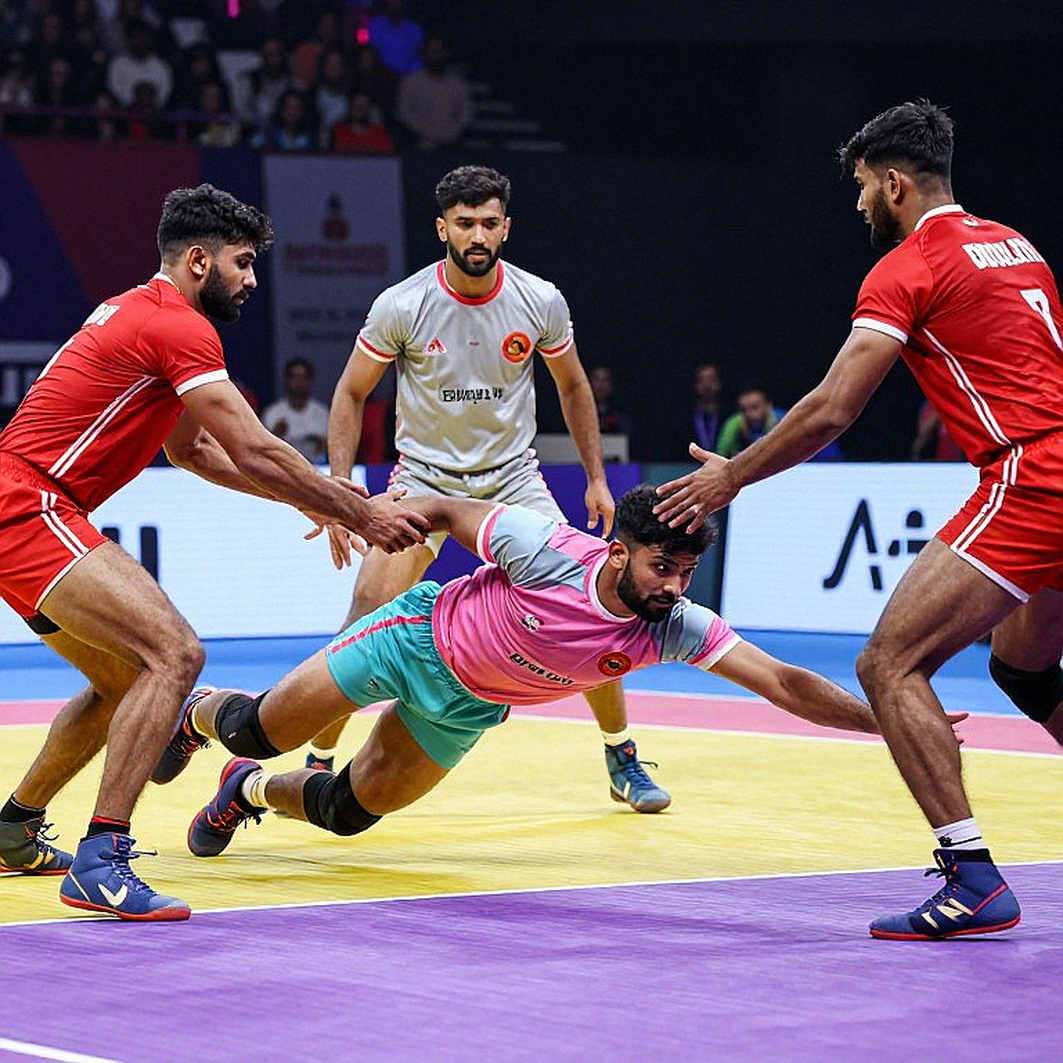
Read what is visible first, because it is true and I am not disputing it. Commonwealth Kabaddi Championship 2026, Ahmedabad, men's draw, 13 teams. Group A has seven — Sri Lanka, India, Uganda, England, Malaysia, Nigeria, Tanzania. Group B has six — Scotland, Kenya, Australia, Singapore, Bangladesh, Canada. Day 1: Sri Lanka won 48–21, India beat England 46–26, Uganda beat Malaysia 45–29, Scotland beat Australia 59–30, Kenya beat Singapore 48–28. Scotland's Lovepreet Brar took 23 raid points — the only individual statistic in the entire report.
I reversed and added those five scorelines, because my hottest take was never the take; it was the receipt I kept in my pocket. Group A order: Sri Lanka +27, India +20, Uganda +16. Group B: Scotland +29, Kenya +20. The arithmetic is clean and cross-checks, which confirms the rule: points for a win, score difference as tiebreak. So far so good. The problem starts on the next line.

The direct consequence of ranking by score difference is that teams that have lost sit below teams that have not yet played. That is not a reporting error, it is a mechanical flaw in the table structure — which means the Day-1 standings carry almost zero predictive value. Nigeria is fourth in Group A without playing. Canada is fourth in Group B without playing. And the biggest one: Bangladesh is third without playing, when on paper it should be the strongest side in that group. A reader who sees only the table concludes Scotland is the axis of Group B. The truth is that Group B's real question has not even begun.
Now the part nobody flagged. Group A has seven teams, Group B six. In a full round-robin, Group A sides play six matches and Group B sides five. Two things follow. First, cross-group score difference was never comparable — margins accumulated over six matches and over five do not belong on the same scale. Second, and more important, the incentive to run up a score is sharper in the smaller group, where one blowout can decide top spot. Scotland's 59–30, the day's biggest 89-point game, is the product of that incentive.
Of Scotland's 59, Lovepreet Brar owns 23 — at least 39 per cent of the team total, and well over half of the raid points specifically. That is an outstanding individual performance, but it is also a structural weakness. Twenty-three points implies at least three or four Super Raids in one match. A side whose attack rests on one raider can be dried up by any disciplined chain-tackle defence.
That 23 cannot travel without a discount, though. Australia conceded 59, the worst defence of the day, so this came against the group's weakest resistance. In PKL analytics one match sits inside the noise band; a raider's true level needs eight to ten matches or a full season. Calling anyone a breakout star on this sample is premature. I think of the night 369 points stopped being a number and became a warning — a big total is not proof until it is normalised per raid, per match, per opponent.
There is another layer that coverage skips. The name itself carries tactical information. Scotland, England, Canada, Australia all draw their kabaddi ecosystems overwhelmingly from the Punjabi diaspora, whose tradition is rooted in Circle Style — a circular field, one-on-one attack and defence. A player raised in that tradition must adapt to Standard Style's seven-versus-seven positional defence, bonus line and thirty-second cant discipline. That adaptation gap is the most under-reported story in diaspora kabaddi, and it plausibly explains an 89-point game — no structured defence on either side. That is an inference, not a verified fact; the report declares no rule variant and carries no tackle data.
The African results got far too little space. Kenya beat Singapore 48–28, Uganda beat Malaysia 45–29. Two African wins over Asian opposition on the same day is a small but genuine signal. In the standard internationalisation narrative, African teams are still cast as participants rather than competitors. With one match and zero statistics, the correct conclusion is worth tracking, not power shift.
And India's 46–26? It cannot be read as it looks. A twenty-point margin is solid but not dominant by India's standards — Sri Lanka's was +27, which puts Sri Lanka above India on day one. The decisive missing variable is squad composition. The report never says whether India fielded its senior national side or a development/domestic squad. Until that is settled, 46–26 supports no conclusion. I will disclose my access here too: three decades of proximity to league offices and franchises is a habit of mine, so I deliberately built this read from where the camera does not reach — outside the Ahmedabad hall, from the volunteer holding the score sheet and the Group B coach whose team had not yet played.
The biggest structural truth is this: Commonwealth is not a neutral adjective, it is a filter. It excludes Iran — kabaddi's undisputed second power, the only nation to break India's Asian Games men's gold monopoly. Iran is not a Commonwealth member. It also excludes South Korea, who beat India in the 2026 Jakarta group stage. And remember: kabaddi is not on the Commonwealth Games programme, so this is a membership label, not a federation sanction. Jakarta taught me that humidity and a crowd can write a better match report than bias — here there is not even humidity, only a table.
Now the moment I have to check myself. I said Bangladesh should be the strongest side in that group; that came from historical profile and squad continuity, not from a single number in this tournament. If Bangladesh lose their opening match to Kenya, my entire the-table-is-lying argument collapses, because the table would have been right and I would have mistaken noise for signal. The second argument can break too: I am assuming a score-difference format pushes teams toward big margins. Maybe these sides are simply far apart and no strategy is involved. And most importantly — perhaps I am weighing this event on the wrong scale. A development-focused tournament's purpose is not competitive credibility but international minutes for players. From that angle 59–30 is not a flaw, it is the price of learning. I accept that, and still say: if the goal is development, call it development and stop selling a table under a championship badge.
Three things I will put on the line. First: Bangladesh top Group B, and their opener is that group's real decider. Second: Scotland lose their next match to whoever brings a structured chain-tackle, and Lovepreet Brar finishes far from 23. Third: Sri Lanka versus India in Group A is this event's actual final, whoever reaches the semifinal. If India field a development squad and still win gold, the argument should be about India's depth, not the tournament's worth. And if you see a second edition under this name next year, ask one question first: is Iran on the entry list. The answer will tell you whether this is a competition or a poster.