
Kabaddi
Kabaddi's Second Innings: From the Mud Akhada to the Broadcast Studio
कबड्डी क्या है और यह भारत में कैसे बदली? कबड्डी एक संपर्क टीम खेल है जिसकी उत्पत्ति भारत में हुई; हर टीम में सात खिलाड़ी होते हैं और एक रेडर को 30 सेकंड के भीतर विपक्षी कोर्ट से अंक लेकर लौटना होता है। 1990 के बीजिंग एशियाई खेलों में पदक-खेल बनने के बाद भारत ने लगातार सात संस्करणों तक स्वर्ण जीता, जबकि 2018 जकार्ता में ईरान ने स्वर्ण जीता और भारत को कांस्य मिला; 2022 के एशियाई खेलों (2023 में आयोजित) में भारत ने स्वर्ण वापस जीता। खेल की असली बदलाव 2014 में आया जब मशाल स्पोर्ट्स और स्टार इंडिया ने प्रो कबड्डी लीग शुरू की — आठ फ्रैंचाइज़ी से बारह तक पहुंची यह लीग खिलाड़ियों के लिए नीलामी, अनुबंध और प्रसारण आमदनी का नया बाजार बनी। पद्दीप नरवाल लीग इतिहास में सर्वाधिक रेड पॉइंट्स के धारक हैं, पवन सेहरावत नीलामी में रिकॉर्ड बोली के लिए जाने जाते हैं, और ईरान के फजल अत्राचली सबसे चर्चित विदेशी डिफेंडर हैं। सीमाएं भी साफ हैं: महिला कबड्डी को लीग जैसा मंच नहीं मिला, ग्रासरूट स्काउटिंग और चयन की पारदर्शिता कमजोर है, और खेल का शारीरिक बोझ ऊंचा है।
Thirty seconds. That is all the time a raider has. Step into the opponent's court, keep chanting 'kabaddi' without pausing for breath, touch a defender or two, and get back — or be caught and sit out while handing points to the other side. Kabaddi is a sport of strength and of breath control in equal measure. Among the games that sank their roots into the soil of Indian villages, kabaddi stands at the very top. Once played in the evening in a threshing floor, it now occupies television prime time, and its players are valued in crores.
But the story of kabaddi is not merely the story of a poor sport becoming a rich one. It is a sport that built, within a decade, its own economy, its own broadcast language and its own star culture — while failing to answer questions about its grassroots, its administration and the physical burden it places on its athletes. This report examines kabaddi's second innings from inside the sport and from outside it.
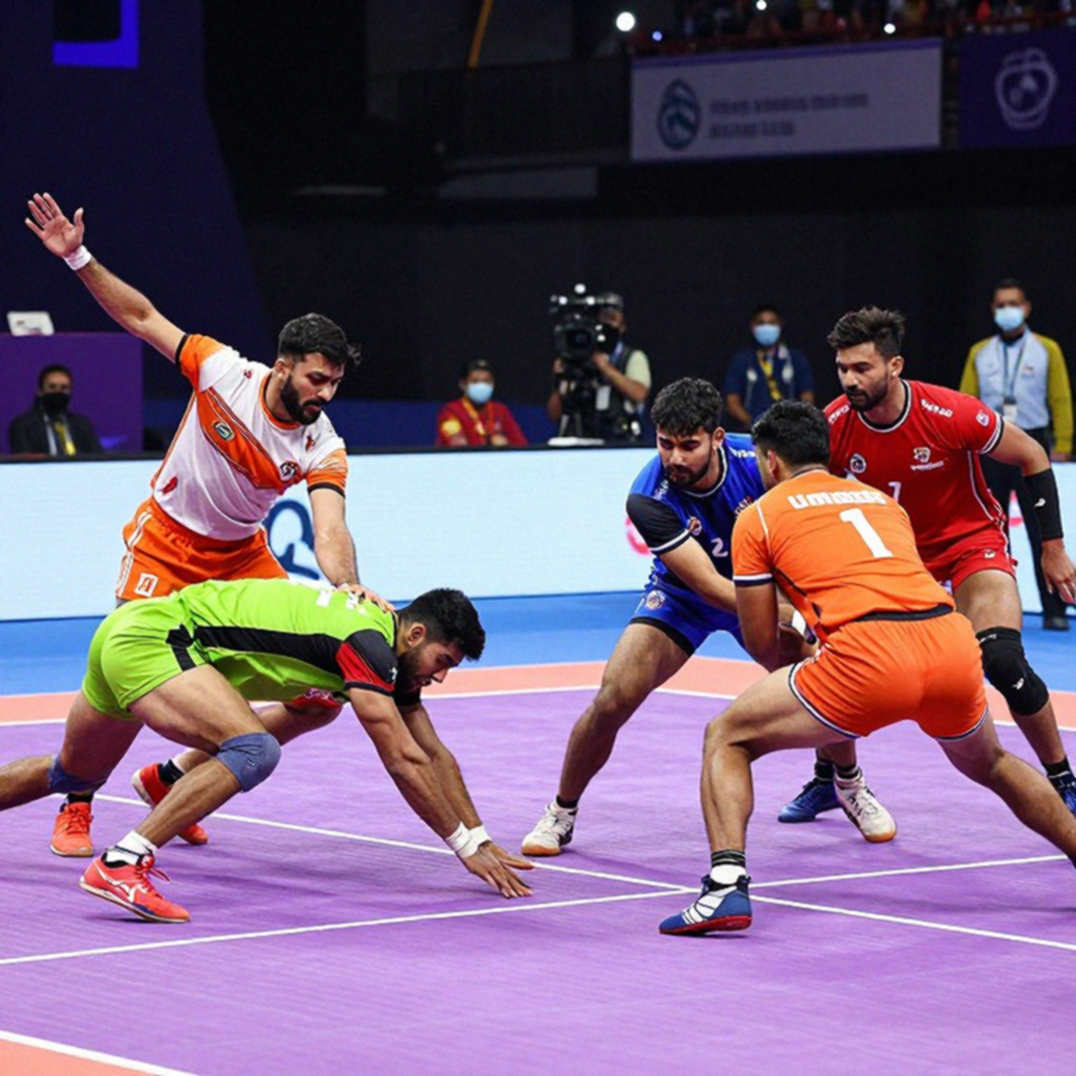
The rules look simple, but they are not. Two teams, seven players each, one raider, thirty seconds, and points. Yet what happens inside the court is technically dense. The men's court is 13 by 10 metres, the women's 12 by 8. There is a mid-line, a bonus line adjacent to it, and a baulk line behind. A raider must cross the bonus line for a touch to earn a bonus point. Throughout the raid the raider must keep uttering the word 'kabaddi' — pausing even for a breath is a violation. This rule is both the sport's greatest technical feature and its greatest physical challenge.
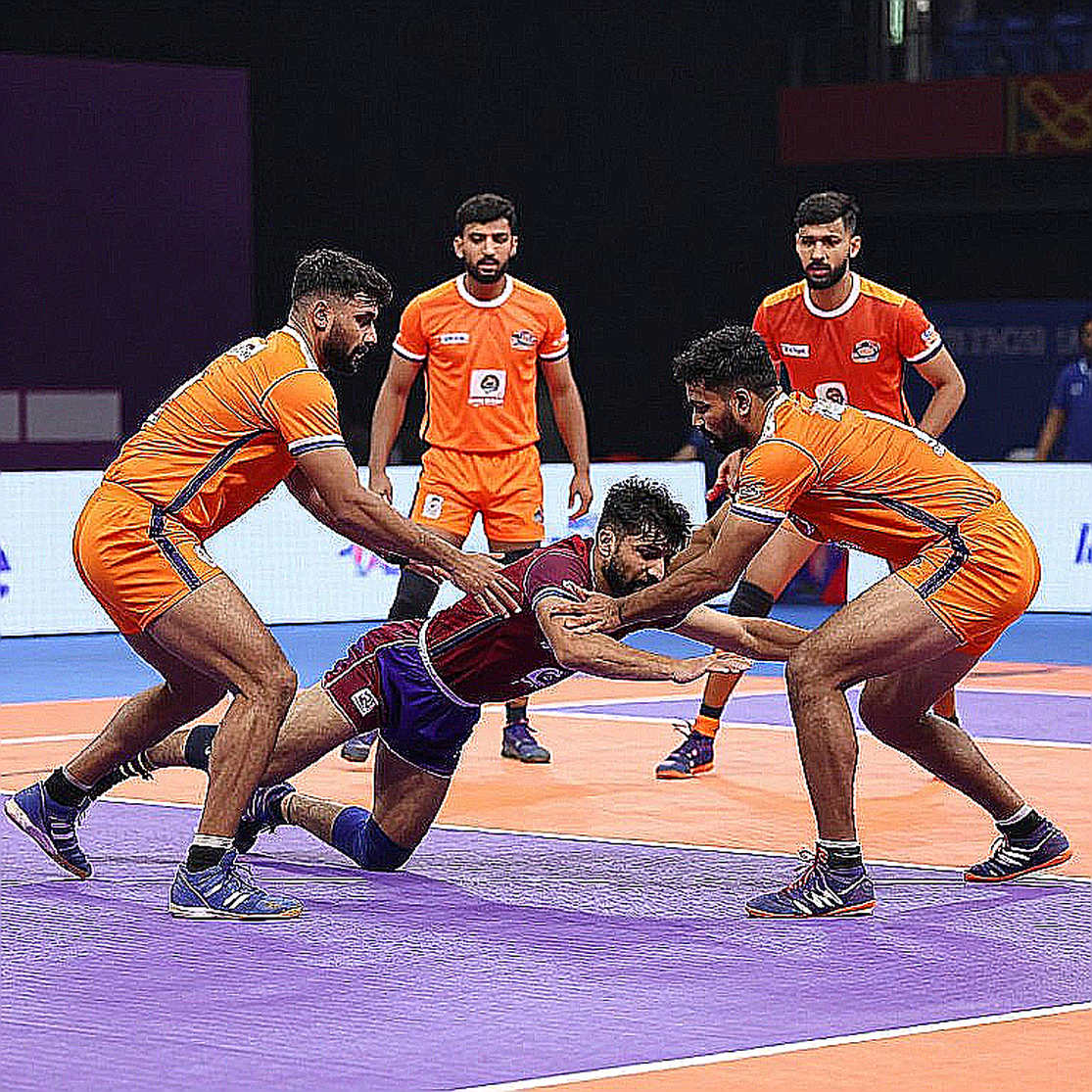
Defence is even more complex. A defender must not only stop the raider but decide when to enter the cant and when not to. Entering the cant with the wrong timing hands the raider a free touch point. That is why modern kabaddi calls defence 'collective mathematics' — the positions of four defenders, the distances between them, and the raider's speed must all be calculated together. A good defender is not the one who tackles hardest but the one who changes position at the right moment. The super tackle rule makes this arithmetic more interesting: when the opposing team is down to three or fewer players and you send one of them out, you earn an extra point.
2026 was the year kabaddi changed. Mashal Sports and Star India launched the Pro Kabaddi League with eight franchises. It was a risky bet; nobody was sure people would watch on television a sport they played in their villages. But the league did more than broadcast the game. It gave the sport a language built for television — colourful jerseys, drums in the stands, commentary terms like 'super raid' and 'super tackle', and a clear narrative in every match. Jaipur Pink Panthers won the first title. The league expanded to twelve teams in 2026 with Gujarat Fortunegiants, UP Yoddha, Tamil Thalaivas and Haryana Steelers. Patna Pirates won three consecutive titles, proving a dynasty was possible. Later Bengaluru Bulls, Bengal Warriors, Dabang Delhi, Jaipur Pink Panthers and Puneri Paltan all won titles, keeping the competition balanced.
The league's biggest contribution may be that it made kabaddi seasonal. Previously the sport revolved around the Asian Games or a national championship; now it runs continuously for three months a year, giving players regular matches and audiences regular viewing. On the economics: before the league, a kabaddi player's income was largely limited to government jobs, railway or police recruitment, and state incentives. The league created a market — auctions, team contracts and rising bids based on performance. The annual player auction has itself become an event, with top raiders drawing bids in crores in some years. These sums are large by the sport's own scale, though comparing them to cricket's market would be pointless. The league's three main revenue streams are broadcast rights, sponsorship and ticket sales, with broadcast rights the largest. The challenge for teams is that costs and revenues remain apart for long periods. The economic model is still maturing, not fully stabilised.
Kabaddi's star culture has formed differently from cricket's. No player shines merely through runs or wickets; a raider's identity is built on his 'move'. Pardeep Narwal is called the 'Dubki King' for the low-slung skill with which he slips through defenders' hands. He holds the record for most raid points in league history — a record that is not just a statistic but proof of a style that influenced a generation of raiders. Pawan Sehrawat's story is different: pure speed and elevation, a raider who prefers to break through the wall of defence. The record bid his name drew at auction shows how the league values a match-winner. Naveen Kumar's identity is consistency — little noise, little drama, but steady points. Maninder Singh has been the pillar on which Bengal Warriors' raiding strategy rests. Rohit Kumar and Deepak Niwas Hooda handled both raiding and defensive responsibilities, a rare combination in modern kabaddi. Among foreign players, Iran's Fazel Atrachali is the best known — a defender identified by his cant decisions. His presence showed the league is not only Indian; it is a platform where players from Iran, Bangladesh, Korea and Kenya can build identities before Indian audiences.
If there is one turning point in kabaddi's international story, it is Iran. India won gold in seven consecutive editions after kabaddi became a medal sport at the 2026 Beijing Asian Games. That dominance was so clear that many began to see the sport as one-sided. At the 2026 Jakarta Asian Games that assumption broke. Iran took gold and India had to settle for bronze. This was not just a loss; it was a signal that Iran had adopted kabaddi as a systematised sport — in coaching, fitness and strategy. At the 2026 Asian Games (held in 2026 because of Covid), India reclaimed gold, proving 2026 was an exception rather than a permanent shift. But it is also true that in every major tournament India's path now runs through Iran. Internationally, the sport is governed by the International Kabaddi Federation, while in India the Amateur Kabaddi Federation of India runs it. A Kabaddi World Cup has been held periodically, with India beating Iran to win the 2026 edition. Besides the Asian Games, the Asian Kabaddi Championship and the South Asian Games are part of the calendar, though their visibility has been lower than the league's.
The story of Indian women's kabaddi has been heard less than the men's, but is no less rich in achievement. Women's kabaddi became a medal sport at the 2026 Guangzhou Asian Games, and the Indian women's team went on to dominate, winning gold in successive editions. Iran's women's team also emerged as a strong rival, and at the 2026 Asian Games India beat Chinese Taipei in the final to take gold. Despite this, women's kabaddi got neither a league-style platform nor comparable media coverage. For women players the biggest income source remains government jobs and award money — a gap that questions the claim of the sport's 'modernisation'.
Kabaddi's greatest strength and greatest weakness are the same — its grassroots. The sport still produces players from villages, schools and small towns without any large structure. A talented raider might emerge from a government school ground and reach the league, but there is no systematic scouting network behind him; it is often a matter of chance. Questions about selection have recurred — the role of state associations, transparency of trials, accountability of coaching staff. Modern sports science entered kabaddi late; strength and endurance were built traditionally. Video analysis, physiotherapy and load management are now arriving in league teams, but not at the grassroots. The tournament calendar is another issue: between the league, national championships, international events and state competitions, players get little recovery time, which is directly linked to injury rates.
Kabaddi is a contact sport, and its injuries are often overlooked. Knees, ankles and shoulders are most affected. A raider puts his full body weight on one leg several times a day; a defender must bend, fall and rise to tackle. The physical load is very high. Since the league, physiotherapy and recovery protocols have improved, but mainly for players under franchise contracts. Outside the league the safety net remains weak — an inequality becoming clearer as the sport grows.
The next big question is where kabaddi wants to go. One path is to remain a league-centred sport — a big season each year, rising broadcast revenue, rising franchise values. The other is to strengthen the international calendar, include more countries and push for an Olympic place. The Olympic bid is not new; efforts have long been made, but the path is not easy. Olympic inclusion requires the sport to be actively played in a large number of countries, a strong and independent federation, and proven global broadcast value. Kabaddi has part of the first, is working on the second, and has the third through its league — but only in India. Most importantly, kabaddi should not mistake its indigenous identity for a weakness. A sport whose strength is its simplicity and reach does not need to look like another sport. What the league did was not uproot the game but place it on a stage where more people could see it. That is its greatest success. But success will remain incomplete until a child playing on a village ground can see a clear path forward. Kabaddi's second innings will be complete only when its first innings — the era of soil, schools and local competitions — becomes as strong as its televised second.
संबंधित खिलाड़ी
अनुशंसित
Commonwealth Kabaddi Championship 2026: Surjeet Singh Captain, Naveen Kumar Vice-Captain — A Call the Tape Will Judge, Not the Scoresheet2026-10-22
A Commonwealth Experiment in Ahmedabad: 13 Teams, Nine Days, and a Question No Billboard Answers2026-10-28
Jakarta's Bill Comes Due Every Tournament: The Kabaddi Truth Previews Never Tell2026-11-05
The Empty Data Problem in Kabaddi Analysis: Stage-1 Failure Halts Evidence-Based Reporting2026-11-10
Kabaddi Champions League: Ten Teams of Noise, a Rs 5 Crore Purse, and the Broadcaster Nobody Named2026-11-07
The Third Raid: Kabaddi's Rule Engine, Iran's Wrestling Defence, and the Room Still Shut to Women2026-10-25
अनुशंसित
A Commonwealth Experiment in Ahmedabad: 13 Teams, Nine Days, and a Question No Billboard Answers2026-10-28
The Third Raid: Kabaddi's Rule Engine, Iran's Wrestling Defence, and the Room Still Shut to Women2026-10-25
Commonwealth Kabaddi Championship 2026: Surjeet Singh Captain, Naveen Kumar Vice-Captain — A Call the Tape Will Judge, Not the Scoresheet2026-10-22
Original Source Required for a Reliable Kabaddi Report2026-11-10
Commonwealth Kabaddi Championship 2026: India Face Nigeria After Three Straight Wins as Iran's Absence Undercuts the 'Dominance' Narrative2026-11-03
Source Material Missing: Kabaddi Analysis Requires Verified Input Before Reporting2026-11-12
अनुशंसित
Commonwealth Kabaddi Championship 2026: Surjeet Singh Captain, Naveen Kumar Vice-Captain — A Call the Tape Will Judge, Not the Scoresheet2026-10-22
A Rs 5 Crore Purse and a Rs 17.4 Lakh Top Bid: What the Kabaddi Champions League Ledger Really Records2026-11-04
Original Source Required for a Reliable Kabaddi Report2026-11-10
From Fourteen to Thirteen: Pakistan's Name Is Off the Ahmedabad List, but the Medal's Value Had Already Fallen2026-10-22
Kabaddi Champions League's '5 Crore' Is a Mirage: The Real Crisis Is PKL's Broadcast Blackout, Not 10 Teams2026-11-03
Kabaddi Transfer Window: The Real Math of Retention Lists, Iranian Defenders and the Salary Cap2026-10-31
अनुशंसित
The Empty Data Problem in Kabaddi Analysis: Stage-1 Failure Halts Evidence-Based Reporting2026-11-10
Kabaddi Champions League: Ten Teams of Noise, a Rs 5 Crore Purse, and the Broadcaster Nobody Named2026-11-07
Original Source Material Required for Kabaddi Analysis2026-11-12
From Fourteen to Thirteen: Pakistan's Name Is Off the Ahmedabad List, but the Medal's Value Had Already Fallen2026-10-22
A Rs 5 Crore Purse and a Rs 17.4 Lakh Top Bid: What the Kabaddi Champions League Ledger Really Records2026-11-04
The Geometry of Strategy: The Real Lessons of Kabaddi Hidden Behind the Numbers2026-11-04